VPN Student Discounts (2026): Every Offer vs the Public Deal
Yes, several VPNs now run student discounts: NordVPN, Surfshark, Proton VPN and ExpressVPN all have offers listed through student-verification services, and CyberGhost has a student landing page. The catch is that a student deal is not automatically cheaper than the public sale running the same day, and none of the offers we found changes what you pay at renewal. Compare the two checkout totals before you verify anything.
We read every offer and every public price on 9 October 2026, in US dollars and before tax. This page is for students and apprentices who want the lowest real cost, and for anyone covering a shared house or a family. If you only need one device for a few weeks, a free tier or a money-back test is the cheaper route; see the questions at the end. Our cheap VPN guide tracks what the regular plans cost once their first term runs out.
Do VPNs offer student discounts?
They do, more than they used to, but the offers come in three different shapes and only one of them is a separate price. Some providers hand you an extra code that stacks on top of the normal deal. Some send you to a private "education store" with its own percentage. And some put a student banner over exactly the same plans everyone else can buy. All of them use the same marketing unit, a percentage off a crossed-out reference price, which makes them look bigger than they are.
NordVPN's own help centre confirms an additional discount for students and apprentices aged 18 to 26. Its offer is listed on both UNiDAYS and Student Beans as up to 79% off a 2-year plan plus 3 extra months; NordVPN's own student page would not load for our reader, so its exact percentage is not confirmed. Surfshark sends students to Student Beans, where the listing advertises an extra 15% code applied at checkout. Proton offers VPN Plus for 12 months at 70% off, verified through Student Beans and Beans iD. ExpressVPN's Student Beans listing advertises up to 87% off its Basic plan plus 4 bonus months. CyberGhost's student page advertises 79% off, but it shows the same plans and the same $2.19 two-year price as its normal checkout.
A student percentage is measured against the provider's crossed-out list price, not against the sale price everyone else gets that week. The only comparison that matters is dollars at checkout.
Every offer we could verify, dated
The table pairs each student offer with the public deal from the same provider on the same day, plus the renewal price that follows. Public prices are US prices read through a US connection on 9 October 2026. The student terms come from the provider's own page where one exists, otherwise from the verification platform's listing. Private Internet Access also appears on Student Beans, but we could not read PIA's US prices, so we leave its numbers out rather than guess.
| Provider | Student offer (where listed) | Public deal the same day | Renews at | What it means |
|---|---|---|---|---|
| NordVPN | Extra discount, ages 18–26 (NordVPN); 'up to 79% off' 2-yr + 3 months on UNiDAYS and Student Beans | Basic $3.49/mo (12 Oct 2026): $94.23 billed for 27 months | Basic $139.08/yr; Complete $219.48/yr | Percentage unconfirmed on NordVPN's site; compare totals |
| Surfshark | Extra 15% code via Student Beans, on top of the regular deal | Starter $2.49/mo, $67.23 for 27 months | Starter $79/yr | The only offer that stacks on the public sale |
| Proton VPN | VPN Plus, 12 months, 70% off (Student Beans / Beans iD) | Plus $3.49/mo, $83.76 for 24 months | Plus $83.88/yr | Student term is 1 year; public deal is 2 |
| ExpressVPN | 'Up to 87% off' Basic + 4 bonus months (Student Beans education store) | Basic $2.99/mo, $83.72 for 28 months | Basic $99.95/yr | Check the store price against $83.72 |
| CyberGhost | Student page advertising 79% off | $2.19/mo, $56.94 for 26 months | $56.94/yr | Same plans and price as the normal checkout |
Two patterns stand out. First, the cheapest public deal on the list, CyberGhost's, needs no verification at all. Second, Surfshark's is the only offer described as an add-on to the normal sale rather than a replacement for it. If that 15% applies to the whole first bill, our arithmetic puts Surfshark Starter at about $57.15 for 27 months instead of $67.23, roughly $2.12 a month. Check the cart total before you pay, because Student Beans does not say which items the code excludes.
Student price vs normal promo price: the side-by-side
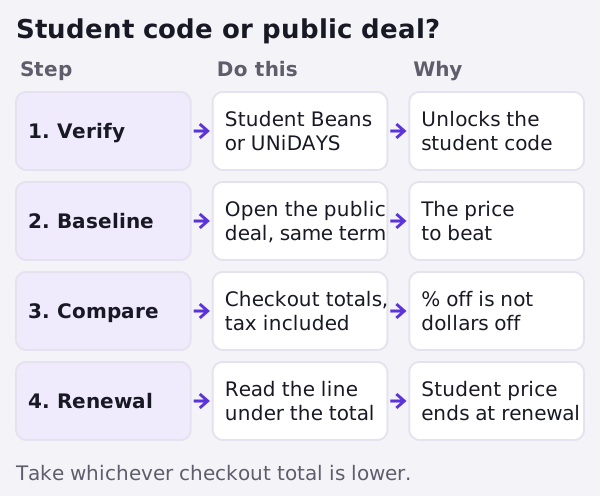
Here is the method we would use for any provider, including ones not in the table. Verify on the platform first, because the code or store link only appears after that. Then open the provider's public pricing page in a second tab and choose the same plan and the same term. Put both carts to the final screen, where tax is added, and compare the totals. Only then look at the term length: a cheaper 1-year student deal can still cost more per month than a 2-year public deal, as Proton's numbers show.
Proton is the clearest example of the term trap. Its student plan is 12 months of VPN Plus at 70% off; Proton's page did not show the dollar figure to our reader, only the percentage. Its public 24-month plan was $83.76, or $3.49 a month. The student plan renews at Proton's regular price for the same 12-month duration, according to Proton's student page, so you should check both the first-year price and that 12-month renewal before choosing. If you want two years of cover, the public plan may simply be the better deal even for a student. You can compare Proton VPN's plans at checkout and stop before paying.
For NordVPN, the honest answer is: compare in the cart. Its own site confirms an extra student and apprentice discount but would not show us the percentage, and the listing platforms quote "up to" figures measured against NordVPN's reference price. Basic on a 2-year plan cost $3.49 a month on 12 October 2026, a $94.23 first bill covering 27 months, and it then renews at $139.08 a year. If the student cart is cheaper than that, take it. Students who want NordVPN specifically can open NordVPN's plans in the second tab.
What happens at renewal
Every student price we found is a first-term price. Proton states that its student plans renew automatically at the regular price. None of the other offers we read claims to discount a renewal, so assume the renewal rates in the table apply to students too. That is where the real gap between providers opens up, and it matters more than the student percentage.
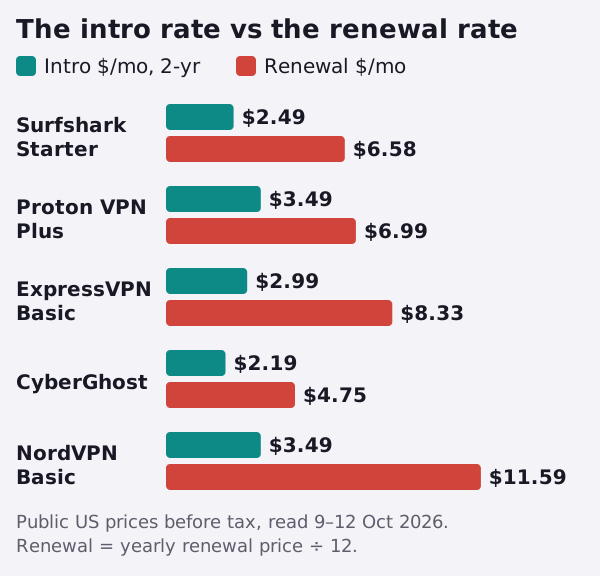
Put another way, the renewal is the price you pay for the rest of your degree. A student who signs up in first year will probably renew once before graduating. The table below adds the first bill to one renewal year, which is roughly what three years of cover costs on each public deal. NordVPN's first bill is the early-October listing, so treat its total as provisional.
| Plan | First bill | Months covered | + 1 renewal year | Total | Months | ≈ per month |
|---|---|---|---|---|---|---|
| CyberGhost 2-yr | $56.94 | 26 | $56.94 | $113.88 | 38 | $3.00 |
| Surfshark Starter | $67.23 | 27 | $79.00 | $146.23 | 39 | $3.75 |
| Proton VPN Plus | $83.76 | 24 | $83.88 | $167.64 | 36 | $4.66 |
| ExpressVPN Basic | $83.72 | 28 | $99.95 | $183.67 | 40 | $4.59 |
| NordVPN Basic | $94.23 | 27 | $139.08 | $233.31 | 39 | $5.98 |
On that measure, CyberGhost's ordinary checkout beats every student offer we could price, because its renewal stays at $56.94 a year. A student who mainly wants low cost over a degree can check CyberGhost's current deal without verifying anything. A student who wants Surfshark's unlimited devices should stack the 15% code on the normal Starter deal, then plan for the $79 renewal.
How verification works
Student Beans and UNiDAYS are verification services, not VPN sellers. You create an account, prove you are a student, usually with a university email address or a document, and the platform then reveals a code or a private store link. The VPN company never sees your coursework, but the platform does hold your student status and email, so read its privacy terms if that matters to you.
Eligibility varies by offer. NordVPN describes its discount as for students and apprentices aged 18 to 26. Proton says its student plans are open to people in full-time education, including university, college, sixth form, high school and apprenticeships. Surfshark's page simply says to verify your student status with Student Beans. When a plan ends, nobody re-checks your status; you just move to the renewal price, which is why the renewal row above matters more than the badge.
Money-back terms do not change for students. Proton's student page says its 30-day money-back guarantee still applies, Surfshark's standard 30-day guarantee runs from sign-up, and NordVPN's 30-day policy covers first purchases. Buying through a student link is still a normal purchase on the provider's website, so the refund route stays the same.
Family plans and the unlimited-devices route
For a household, the device allowance matters more than any family label. Device limits read on 9 October 2026: Surfshark, Private Internet Access and IPVanish allow unlimited simultaneous devices, with PIA noting compatible devices; NordVPN allows 10, and a router counts as one; Proton VPN Plus allows 10; ExpressVPN's three tiers allow 10 (Basic), 12 (Advanced) and 14 (Pro); CyberGhost allows 7. Surfshark's 7-day trial is capped at 3 devices, so a family test needs the paid plan and its 30-day refund window.
If one person pays and everyone shares, unlimited devices removes the counting problem entirely. If the house wants separate logins, a shared plan does not give you that, and you would need separate subscriptions or a provider that offers multiple accounts. We could not verify a dedicated NordVPN family plan on a page we could read, so we do not recommend one. For most households, Surfshark's unlimited-device plan is the simplest single subscription.
The maths for a shared household
Split four ways, Surfshark Starter's first bill of $67.23 for 27 months comes to about $0.62 per person per month. At renewal, $79 a year shared by four is about $1.65 each per month. ExpressVPN Basic, which allows 10 devices, works out at $83.72 for 28 months, or about $0.75 each for four people, then $99.95 a year at renewal, about $2.08 each. CyberGhost's 7-device cap suits a smaller house: $56.94 for 26 months is about $0.55 each, and its renewal is the same $56.94 a year.
The division is easy; agreeing who pays the renewal is harder. Put the renewal date in a shared calendar the day you buy, and decide in advance whether to renew or switch. If nobody owns that decision, the card on file pays the full renewal by default. Our guide to monthly vs annual vs 2-year VPN plans explains why the long term is usually cheapest for a group.
Beware fake student and family 'deals'
Coupon sites love the words "student" and "family" because they convert, and that attracts weak offers. Three warning signs: an unknown brand with a steep student percentage and no published audit; a "lifetime family plan" from a company you cannot find any history for; and a code that only works on a plan length you did not want. Lifetime VPN deals have a poor track record, as our page on whether a lifetime VPN is worth it shows.
A legitimate student offer from an established provider is fine if the checkout total beats the public sale and the renewal is one you can live with. Anything else is marketing. If an offer only shows a percentage and never a dollar total before payment, walk away; every provider in our table shows the full amount on its final checkout screen.
Edge cases
- You are 27 or over and in education. NordVPN's offer is described for ages 18 to 26; the Proton and Surfshark pages we read mention no age limit. Check the platform's eligibility screen before you rely on it.
- You already subscribed at the public price. Student codes are generally for new purchases; none of the pages we read promises to convert an existing plan. Use the money-back window if you are inside it and the student total is clearly lower.
- You pay through an app store. Student codes are applied at the provider's web checkout. App store purchases follow Apple's or Google's refund rules instead of the provider's.
- You want a free option. Proton VPN Free sets no data cap, connects to servers in 10 countries chosen by Proton, and covers one device. It is not a student offer, but it costs nothing.
Common questions
Is there a VPN student discount?
Does NordVPN have a student discount?
What is the best VPN student discount?
Do student VPN prices go up at renewal?
What's the cheapest way to cover a family with a VPN?
Weigh this against the whole field: see what cheap VPNs really cost over time, or read how VPN free trials and money-back guarantees actually work.