ExpressVPN Price (2026): Basic, Advanced and Pro After the Intro Deal
ExpressVPN's cheapest way in costs $83.72: that is the Basic tier on the 2-year plan, which ExpressVPN advertises as $2.99 a month and which actually runs for 28 months because four bonus months are added. After that the subscription auto-renews at $99.95 a year. Advanced costs $125.72 up front and renews at $119.95, and Express Pro costs $209.72 and renews at $199.95. We read every figure here from ExpressVPN's US pricing and order pages on 18 October 2026, and read the 2-year prices again on 26 October 2026, unchanged; all are in US dollars, before any sales tax added at checkout.
Who should pay it? Someone who wants ExpressVPN's apps and its Lightway protocol, will use the VPN for years, and is fine with a second bill roughly three times the advertised monthly rate. If your budget is fixed, or you only need a VPN for a few weeks, the term and tier choices further down matter more than any coupon.
One caution before the numbers: the pricing page we read carried a Halloween banner promising savings of up to 80%, so these are promotional first-term prices. ExpressVPN changes them often. Compare the total on your own checkout screen with this dated snapshot rather than trusting either blindly.
Every plan and term, priced (18 October 2026)
ExpressVPN now sells three tiers, Basic, Advanced and Pro, and the two pages we read offered them on two terms. The pricing page leads with 2-year plans that include four extra months; the order page lists 1-year plans that include three extra months. Neither page offered a 1-month term on the day we looked, so we don't quote one. When we looked again on 26 October 2026 the pricing page showed only the 2-year plans, so treat the 1-year rows as the 18 October offer. The first payment covers the whole first term, and every tier comes with ExpressVPN's 30-day money-back promise for first-time customers.
| Tier | Term | Advertised rate | First bill | Renews at | 3-year cost |
|---|---|---|---|---|---|
| Basic | 2 years + 4 months | $2.99/mo | $83.72 for 28 months | $99.95/yr | $183.67 |
| Basic | 1 year + 3 months | $4.99/mo | $74.85 for 15 months | $99.95/yr | $274.75 |
| Advanced | 2 years + 4 months | $4.49/mo | $125.72 for 28 months | $119.95/yr | $245.67 |
| Advanced | 1 year + 3 months | $5.99/mo | $89.85 for 15 months | $119.95/yr | $329.75 |
| Pro | 2 years + 4 months | $7.49/mo | $209.72 for 28 months | $199.95/yr | $409.67 |
| Pro | 1 year + 3 months | $8.99/mo | $134.85 for 15 months | $199.95/yr | $534.75 |
The 3-year column is the first bill plus however many yearly renewals it takes to stay covered for a minimum of 36 months. With the 2-year plan that means one renewal, which carries you to month 40; on the 1-year plan it is two renewals, reaching month 39.
What separates the tiers is mostly what sits around the VPN. Basic covers 10 devices at once and blocks ads, malicious sites and adult sites. Advanced raises the limit to 12 devices, adds tracker blocking, the ExpressKeys password manager and Identity Defender, which ExpressVPN describes as five ID alerts, automated data removal and identity-theft insurance of up to $3 million, plus a one-off 3 GB travel eSIM from holiday.com. Pro allows 14 devices, includes a dedicated IP (an add-on on the lower tiers), raises the insurance ceiling to $5 million, and adds an AI chatbot with 500 credits a day. ExpressVPN's footnote says Assurant's American Bankers Insurance Company of Florida underwrites the insurance, with its own terms and exclusions. The VPN itself, with servers in 113 countries, is the same on every tier.
How big the renewal jump is
Turn each renewal into a monthly figure and the step becomes clear. Basic goes from an advertised $2.99 to about $8.33 a month, nearly 2.8 times as much. Advanced goes from $4.49 to $10.00 and Pro from $7.49 to $16.66, each roughly 2.2 times the intro rate. In other words the cheapest tier has the steepest cliff, which is the opposite of what most people expect when they pick the entry plan to keep costs down.
The discount badges hide this. Basic's 2-year card shows "Save 80%" next to a struck-through $419.72. That figure is exactly 28 months at $14.99, and the small print explains that discounts are measured against "the current monthly service price for the selected tier". The same arithmetic gives $16.99 for Advanced and $22.99 for Pro. So the saving is calculated against a month-by-month price that neither page offered as a plan, not against the $99.95 renewal you will actually face. Measured against the renewal rate instead, 28 months of Basic would cost about $233, so the real first-term saving is closer to 64%. Our explainer on how intro and renewal VPN pricing works walks through why providers anchor their badges this way.
Read the line under the price, not the price. On every ExpressVPN card it says, in full, how much the first term costs and what it auto-renews at.
The three-year bill, tier by tier
Per-month prices are hard to compare across terms of 15, 28 and 12 months, so we stacked the actual charges. The chart uses the 2-year plan, the cheapest route for anyone staying longer than about a year and a quarter.
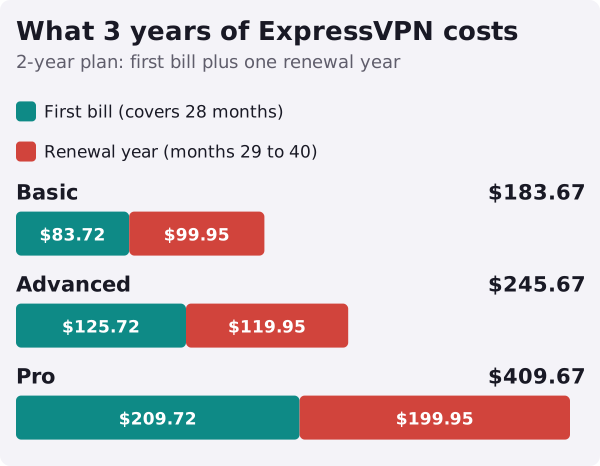
Basic adds up to $183.67 for 40 months of service, which averages about $4.59 a month: more than half as much again as the $2.99 headline, though still modest. Advanced reaches $245.67 and Pro $409.67. In every tier the single renewal year is a bigger share of the total than you might guess, from 49% on Pro to 54% on Basic, because one year at the full rate costs more than 28 months at the promotional one.
The 1-year route is cheaper on day one, $74.85 against $83.72 for Basic, and that is its trap. The 15-month term ends 13 months sooner, so the first $99.95 renewal lands at month 15, and by month 39 you have paid $274.75. Unless you are confident you will cancel within about 15 months, the 2-year plan wins. We run the same break-even test for other providers in monthly vs annual vs 2-year VPN plans.
How the renewal compares with other VPNs
A renewal price only means something next to the alternatives. We lined up the yearly price each provider charges from the second bill onward, for its entry tier, using pages read in October 2026.
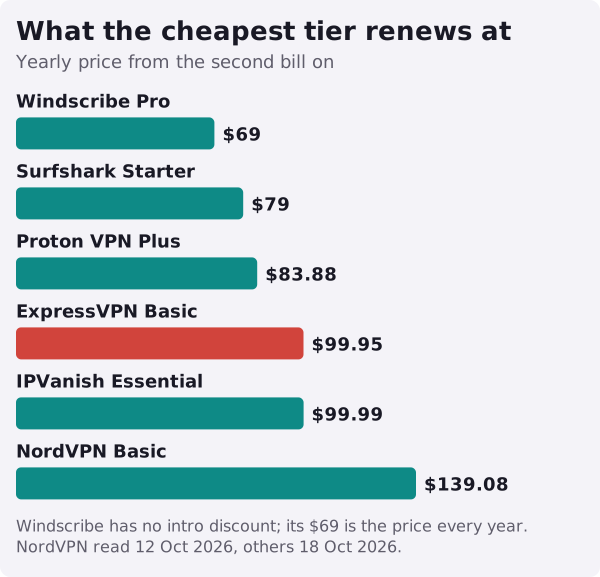
ExpressVPN Basic renews in the middle of the pack: about $21 a year above Surfshark Starter, $16 above Proton VPN Plus, and almost level with IPVanish Essential at $99.99. NordVPN Basic, at $139.08 when we read its renewal table on 12 October, costs nearly $40 a year more. Windscribe is the outlier with a flat $69 yearly price and no intro discount to lose; it runs no affiliate program, and we mention it because it's the cheapest renewal in this group. If renewal cost decides it for you, our cheap VPN rankings by three-year cost put these side by side.
Ways to pay less without a coupon
Coupon sites promise codes that beat the checkout price, but ExpressVPN's pages describe the intro rate as the discount. A few legitimate moves do change the total over the life of a subscription.
- Choose the term by how long you will really stay. Under about 15 months, the 1-year plan's smaller first bill wins; beyond that, the 2-year plan's extra 13 months of cover at the promotional rate makes it cheaper.
- Pick the tier for the VPN, not the extras. Advanced renews at $20 a year more than Basic, and Pro at $100 more. The password manager, identity alerts and insurance only pay off if you'd otherwise buy them separately.
- Diary the renewal date a month early. That gives you time to compare the $99.95 renewal with what a new provider charges that week, tax included, before the card is charged.
- Use the guarantee as a trial. ExpressVPN's 30-day money-back guarantee covers new users on every tier, so testing it on your own devices costs nothing if you ask for the refund in time. Our guide to VPN money-back guarantees lists what each provider excludes.
Teams are a separate case: ExpressVPN for Teams sells bulk licences with a five-licence minimum, and its pricing isn't on the consumer pages, so we haven't included it.
Edge cases that change the price
- Sales tax. Both pages say tax is applied at checkout where applicable, so the headline is never the final figure in states that tax digital services.
- Promotions end. The banner on 18 October was seasonal. A later visit may show different intro prices; the renewal prices printed on each card are the figures to compare.
- Dedicated IP. It is an optional extra on Basic and Advanced, and its price wasn't shown on the pages we read. Pro includes one.
- Insurance cover. The identity-theft insurance on Advanced and Pro is an insurance policy with its own exclusions, set out in ExpressVPN's summary-of-benefits documents, not a promise of reimbursement for any loss.
- Repeat customers. The refund promise is written for first-time users, so a second purchase after a refund may not qualify.
Is ExpressVPN worth it at the renewal price?
At $99.95 a year after the first 28 months, ExpressVPN Basic is not the cheapest VPN to keep, but it isn't the most expensive either, and the 2-year plan's three-year total of $183.67 is reasonable for a provider with servers in 113 countries, RAM-only TrustedServer infrastructure, and a June 2025 KPMG assurance report on its privacy commitments. The upper tiers are a different calculation: Advanced and Pro are worth it only if you'd use the bundled tools.
Our verdict: take Basic on the 2-year plan if ExpressVPN is the VPN you want, and set a reminder for month 27. If price matters more than the brand, a cheaper renewal elsewhere will save roughly $16 to $31 a year. You can see ExpressVPN's current plans (affiliate link; it doesn't change our numbers), or compare the Surfshark value breakdown and our NordVPN renewal-price guide first.
Common questions
How much is ExpressVPN per month?
What does ExpressVPN cost after the first term?
Is the 1-year or 2-year ExpressVPN plan cheaper?
Does ExpressVPN have a free trial?
Why does ExpressVPN say I save 80%?
Affiliate link. We may earn a commission — it never moves a ranking.
Weigh this against the whole field: see what cheap VPNs really cost over time, or read how VPN free trials and money-back guarantees actually work.